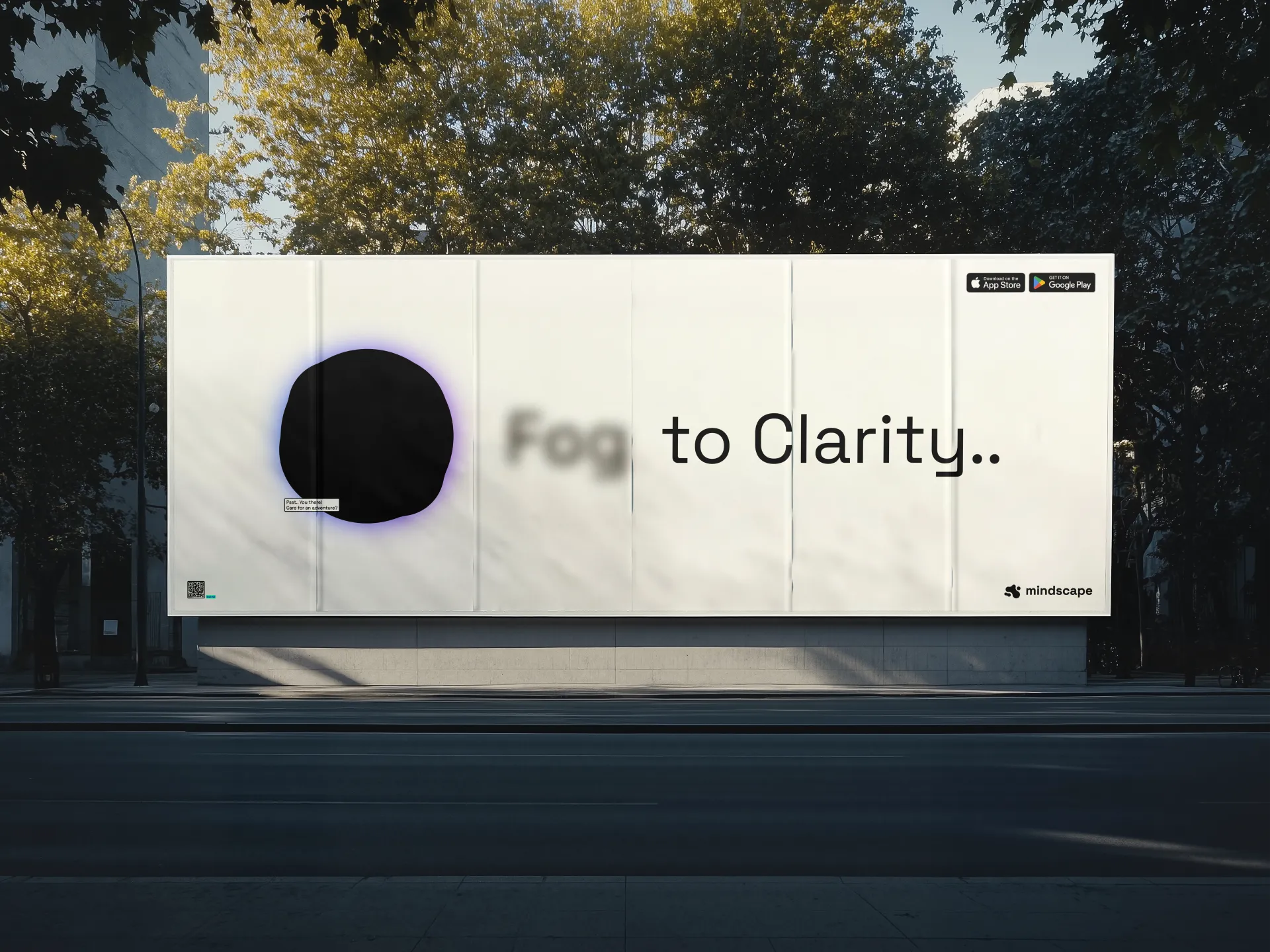
Mindscape A tool for shaping your inner workspace; the project this entire glossary refers to.
That’s what Mindscape is built to do. An AI companion generates a continuous arc of quests — daily, weekly, monthly — calibrated to where you are and what you’re working toward. A surrealist world, unique to each user, shifts in response to what you do. A daily completed, a weekly arc closed, a monthly milestone reached — the environment registers all of it. Not as a streak counter or a progress bar, but as a world that visibly changes. The smallest action moves something. Over time, the structure itself transforms.
These systems aren’t separate features. They’re one thing.
Origin
The project began as a game titled “Unfaded” — a surrealist experience designed around the same therapeutic principles as the Interactive Surrealism thesis. The pivot happened when the question shifted: why constrain this framework to a single playthrough? “Unfaded” could reach one person once. A platform could reach every user, continuously, with a world unique to each of them. The game became Mindscape.
The Ecosystem
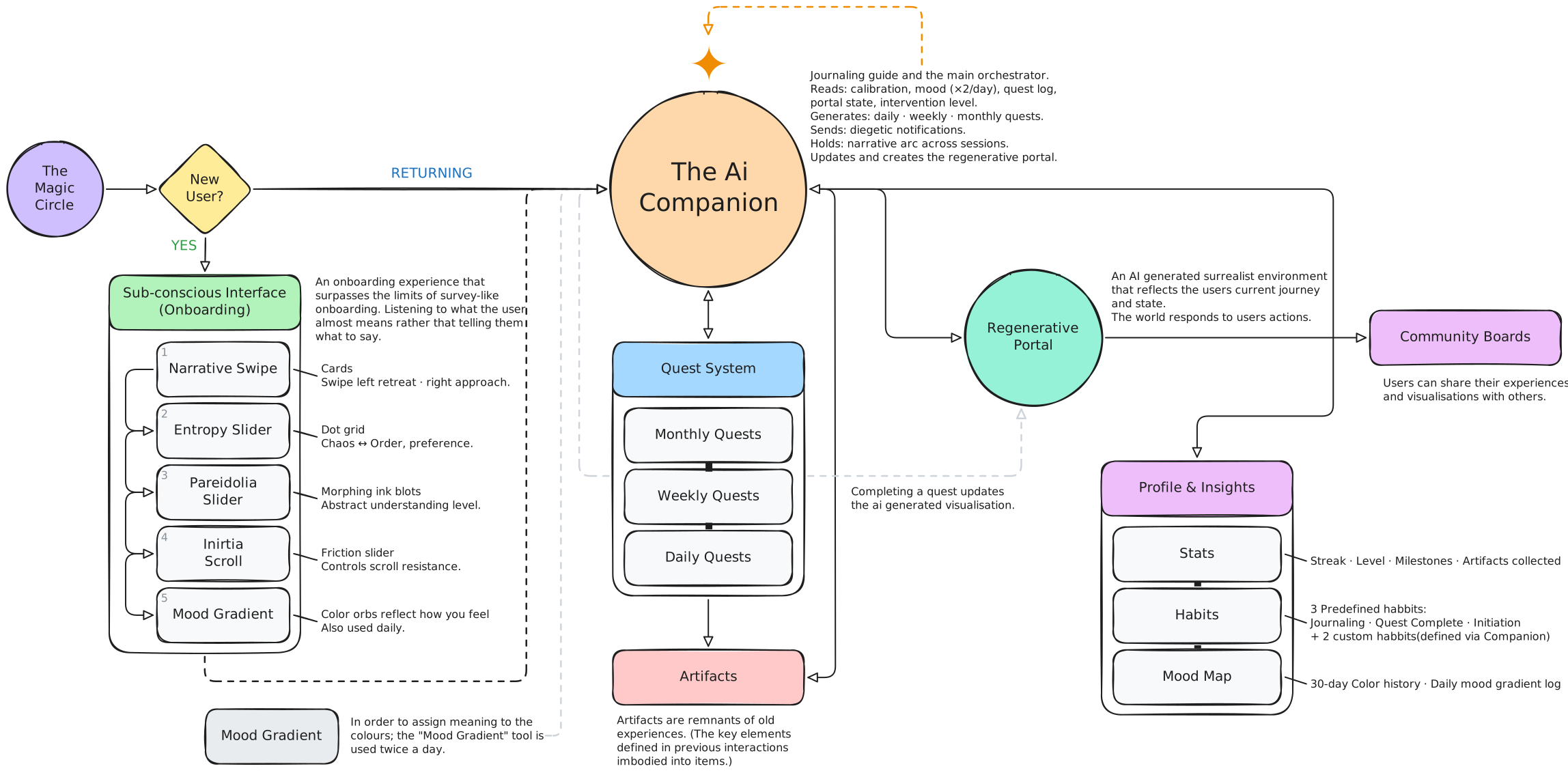
Everything in Mindscape starts with a threshold. The Magic Circle — a long-press mechanic with ramping haptic feedback — creates a deliberate boundary between the outside world and the Mindscape environment. It’s not navigation. It’s a commitment. You’re choosing to enter your inner world, and the system registers that choice before it does anything else.
As a new user, you are not met with clinical, survey-like onboarding. Instead, you’re met with the Subconscious Interface — a set of behavioral mechanics that observe how you move before asking how you feel. It begins with a single text input (what are you here to work on?), which orients everything that follows, and then runs through five mechanics: a narrative swipe measures your coping style; an inertia scroll reads psychomotor energy; an entropy slider asks where you sit on the spectrum from chaos to order; a pareidolia slider gauges your tolerance for abstraction; a mood gradient captures your current affect. No questionnaire. The system watches what you do and draws its own conclusions — a profile that everything downstream is built from. The mood gradient also resurfaces daily, seeding the Companion with a fresh signal every morning and evening.
The Companion is what keeps the arc moving. It acts as a dungeon master for your inner world — reading your profile, generating quests, holding the narrative across weeks and months. Its physical form is the Blob : a reactive fluid entity that shifts in response to your tone, your pacing, what you’re carrying. It doesn’t read as a product mascot. It reads as physics.
The Companion generates quests at three scales — daily, weekly, monthly — calibrated not just to your goals, but to how you process things. The same underlying logic, two different languages:
For a user who needs grounding
Monthly: Improve behavior and overcome anger.
Weekly: Identify 3 emotional triggers.
Daily: Reflect on 3 things that happened today and how you felt toward them.
For a user who works in symbol
Monthly: Stabilize the Monolith.
Weekly: The Archive of Echoes — preserve one memory before it fades.
Daily: Whisper to the Void. Tell it one specific thing your brother laughed at.
The architecture is the same. The language adapts.
The Companion generates your regenerative portal — a surrealist environment unique to each user, built from the full picture of who you are: your onboarding profile, your Companion interactions, your journaling, your quest history. Not a dashboard. Not a score. A place. Take a user dealing with burnout. Their goal is to get through it. That state — burnout, filtered through their profile — might generate a monochrome, lifeless studio: cold walls, tools left on the floor, no light getting in. The Companion works with that world. Quests and journal prompts arrive through it: “What was the last tool you laid down?” Notifications sound like someone who knows you: “The studio seems cold. Let’s bring some light into it.” Another user might get a dead forge — dark iron, no heat, no motion. Complete a daily quest and a shaft of light breaks through. Close a weekly arc and the forge lights. Hit a monthly milestone and the room fills with color. The portal is the record of the work, not a report on it.
The Profile page tracks your history across the platform: stats, achievements, habits, and Companion interactions. It also includes a mood map — a 30-day color grid drawn from your daily mood gradient inputs, showing how your emotional state has shifted over the past month.
The Intervention Slider lives in Settings. It controls how active the Companion is outside the app — running from The Silent Witness, where it goes quiet and waits for you, to The Active Guide, which checks in proactively and nudges you toward your quests. At any level, the Companion talks like a companion, not a platform. “Hey, what have you been up to today?” “Psst — looks like you haven’t checked today’s quests yet.” It’s not pushing you. It’s asking.
Grounding
The design language across all of this draws directly from the Transformative Triad — the framework synthesized from the Interactive Surrealism research. Symbolic Narratives, Procedural Mechanics, Dynamic Aesthetics. Each component of Mindscape is an instance of one or more of these principles in practice. The Magic Circle is a threshold ritual — Symbolic Narrative. The Subconscious Interface A UI that mirrors the user’s pre-articulate intent — listens before it speaks, surfaces what’s almost-thought.
The research became a framework. The framework became a product. The product is still running on the same three ideas.
Status
Mindscape was built in roughly two months under graduation project constraints, supervised by Dr. Deaa Bataineh. What exists is a coherent high-fidelity prototype — not a market-ready product. The core systems are designed and demonstrated. Reaching launch-grade reliability requires a larger team, deeper clinical research, and sustained development runway.
The foundation is solid. The work continues.