The brief was deceptively open. Come up with a societal or personal dilemma. Propose solutions. Write a paper.
I kept coming back to the same thing: people are struggling — with disconnection, with emotional weight they can’t articulate, with experiences they don’t have language for. And I kept thinking about games. Not as distraction, but as something else — as systems capable of reaching the parts of a person that direct conversation can’t.
The question I brought to my graduation thesis was this: how can surrealist principles be embedded into interactive systems to produce meaningful internal change in players? Not visual novelty. Not atmosphere. Actual transformation — the kind that shifts how a person sees themselves or the world after they’ve put the controller down.
That question became a research paper titled Interactive Surrealism: Creating Transformative and Interactive Experiences — and eventually, a domain I came to define as Interactive Surrealism itself.
Why Surrealism
Video games have evolved into a medium that surpasses simple entertainment, providing significant opportunity for the exploration of complex concepts and the elicitation of powerful emotional responses. Their inherent interactivity allows players to engage directly with narratives and environments, challenging perceptions and fostering introspection. This capacity for abstraction and dynamic system engagement aligns video games closely with surrealist principles — which focus on exploring the subconscious, recontextualizing the familiar, and defying conventional logic to reveal deeper truths about human experience.
Surrealism emerged in the early 20th century as an attempt to access what rational thought misses. André Breton and Salvador Dalí built a design language for the subconscious from within the movement’s core. The manifesto Breton wrote in 1924 described it as “pure psychic automatism”: thought operating freely, unconstrained by reason or societal convention. Freud’s dream interpretation provided the theoretical foundation; the artists provided the technique. René Magritte arrived at the same logic from outside the Paris circle — working independently in Brussels, rarely engaging with Breton’s institutional surrealism — which only reinforces the point: these principles weren’t one movement’s invention. They described something more fundamental about how images reach the mind.
What video games add to this is participation. A painting can confront you with the subconscious. A game makes you act within it. The player isn’t an observer of surrealist logic — they navigate it, make decisions inside it, feel its feedback. That’s a meaningfully different thing. And it’s where the research started.
Research Questions
Four questions structured the inquiry:
- How can surrealist principles — juxtaposition, subversion, abstraction — be effectively incorporated into video game design to create engaging and transformative player experiences?
- In what ways can video games serve as a platform for exploring complex emotional and psychological themes, drawing from surrealist techniques and philosophies?
- How can a surrealist game contribute to the understanding of video games as a legitimate and impactful form of art?
- To what extent can the therapeutic potential of surrealist games be harnessed to address personal and societal issues?
The fourth question is the one I kept returning to. If the medium can externalize grief, guilt, anxiety, and disconnection through symbolic systems — and let players move through those systems rather than just witness them — then it’s doing something that goes beyond art. It’s doing something therapeutic.
Methodology
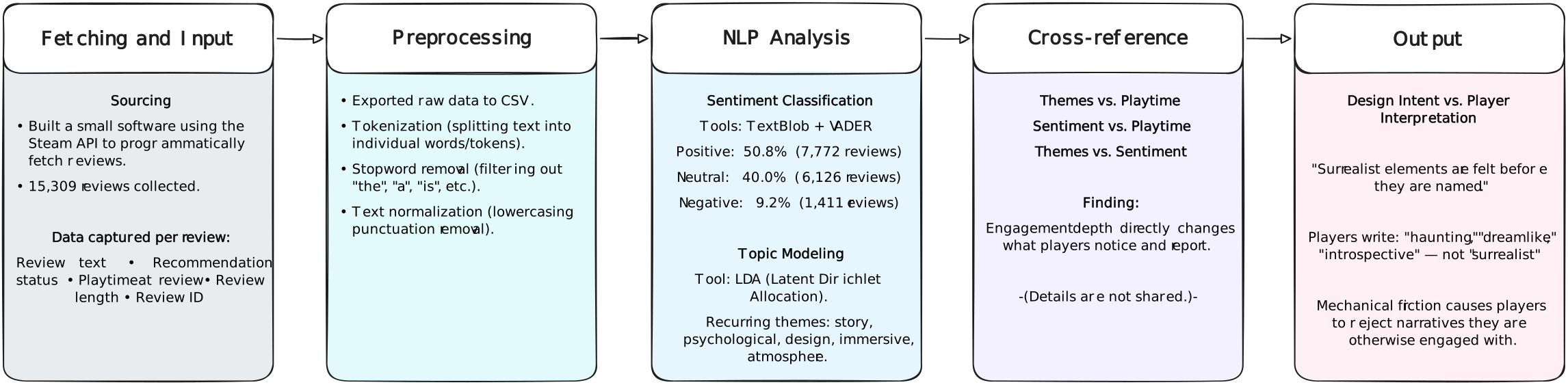
The research ran in four phases: a comprehensive literature review, a conceptual framework, four in-depth case studies, and an empirical analysis of over 15,000 player-generated Steam reviews.
The literature review established the theoretical ground — Breton and Freud for the surrealist foundation; Bogost’s procedural rhetoric for understanding how game mechanics communicate meaning; Juul’s duality of rules and fiction for understanding how games hold together both the structural and the symbolic; and the MDA framework (Mechanics, Dynamics, Aesthetics) as the structural lens for designing surrealist experiences intentionally.
The Steam review analysis was where the research got interesting empirically. Working with a collaborator on the data pipeline — collecting reviews, running sentiment classification through TextBlob and VADER, applying Latent Dirichlet Allocation for topic modeling — produced a dataset of 15,309 reviews for the 2024 Silent Hill 2 remake, segmented into a majority positive, a substantial neutral segment, and a small negative cohort, then cross-referenced with playtime metrics to see whether engagement depth correlated with sentiment.
It did. Players with extended playtime consistently surfaced themes of psychological depth, emotional resonance, and personal connection in their positive reviews. Players with shorter playtime were more likely to critique mechanics. The surrealist elements — abstraction, symbolism, atmosphere — consistently landed with players who stayed long enough to encounter them. The friction was almost always functional: controls, pacing, accessibility. Design intent versus player experience, tracked through real data.
The Case Studies
Four games were selected for the depth of their surrealist application — each illuminating a different facet.
Silent Hill 2 Externalized psychological conflict through environment. The town of Silent Hill isn’t a setting — it’s a projection. Grotesque spaces mirror the protagonist’s guilt. Creatures embody repression. Fragmented narrative requires players to construct meaning themselves. What it proved: symbolic environments can make abstract psychological states inhabitable.
Gris Abstracted grief into aesthetic structure. Each stage rendered a distinct emotional register — shifting colors, new movement abilities, evolving soundscapes. No dialogue. No instruction. Players project their own grief onto a protagonist’s. What it proved: emotional process can be designed as a mechanical journey.
Journey Stripped everything back to movement, anonymity, and sound. Anonymous multiplayer created a mechanic that made human companionship feel rather than explain itself. What it proved: minimalist abstraction, executed with precision, can access existential themes more effectively than narrative exposition.
Baba Is You Made surrealism’s subversion of logic the core mechanic. Players don’t navigate a surrealist world — they rewrite its rules. Rearranging text blocks changes what the game physically allows. What it proved: surrealism’s rejection of fixed logic can be embedded directly into interaction.
Each case study confirmed the same pattern: when surrealist technique operates at the level of mechanics and aesthetics simultaneously — not just skin-deep — players engage on a different register. The theme doesn’t arrive through story. It arrives through experience.
The Unified Framework
From the literature and the case studies, five components emerged as the architecture for surrealist game design.
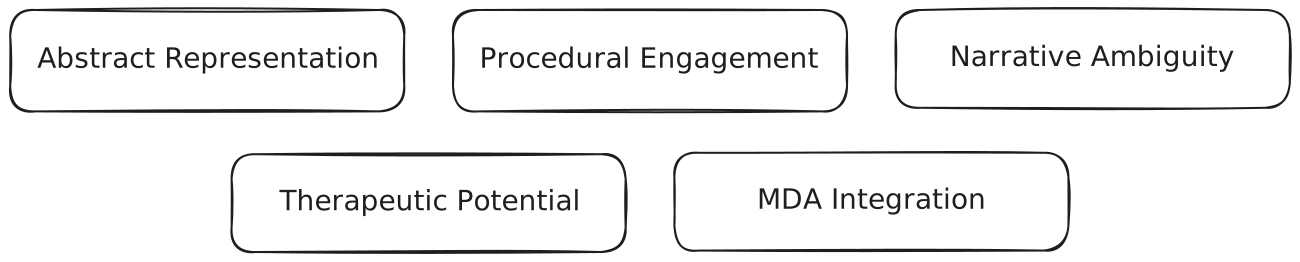
Abstract Representation Symbolism embedded in visuals and mechanics rather than stated. Grief as color. Guilt as creature design. Disconnection as environmental fragmentation.
Procedural Engagement Interactive systems that challenge convention and foster creative thinking. Not passive observation of surrealist logic but active participation in it. Players as co-creators of meaning.
Narrative Ambiguity Fragmented, open-ended storytelling that invites interpretation rather than delivering conclusions. The player brings their own subconscious to fill the gaps.
Therapeutic Potential The capacity of symbolic, interactive experience to externalize internal states, creating a safe space for emotional processing. Rooted in the same Freudian principle that grounded surrealism at its origin.
Integration of MDA Mechanics that subvert expectations; dynamics that draw players into the space of questioning; aesthetics that do psychological work, not decorative work. All three working as a coherent system.
What the Research Found
The clearest finding was also the most obvious once you see it: surrealism works in games when the surrealist principle is structural, not decorative. A game with dream-like visuals over conventional mechanics isn’t surrealist — it’s aesthetic. A game where the mechanics themselves subvert logic, where the environment responds to psychological state, where ambiguity is built into the narrative architecture — that’s Interactive Surrealism.
The therapeutic potential is real, but conditional. It requires balancing abstraction with accessibility. The data showed this tension plainly: what positive reviewers loved about Silent Hill 2 (psychological depth, atmosphere, symbolic resonance) was exactly what negative reviewers found alienating (opaque mechanics, lack of guidance). The surrealist experience worked on players who entered it with patience. The design challenge was engineering that condition rather than hoping for it.
Five components is useful for analysis. Less useful mid-production when you need to make a fast decision. What the five collapse into — the synthesis that came from distilling this research further — became the Transformative Triad. Three things. Always three things. That’s covered in Part II.